
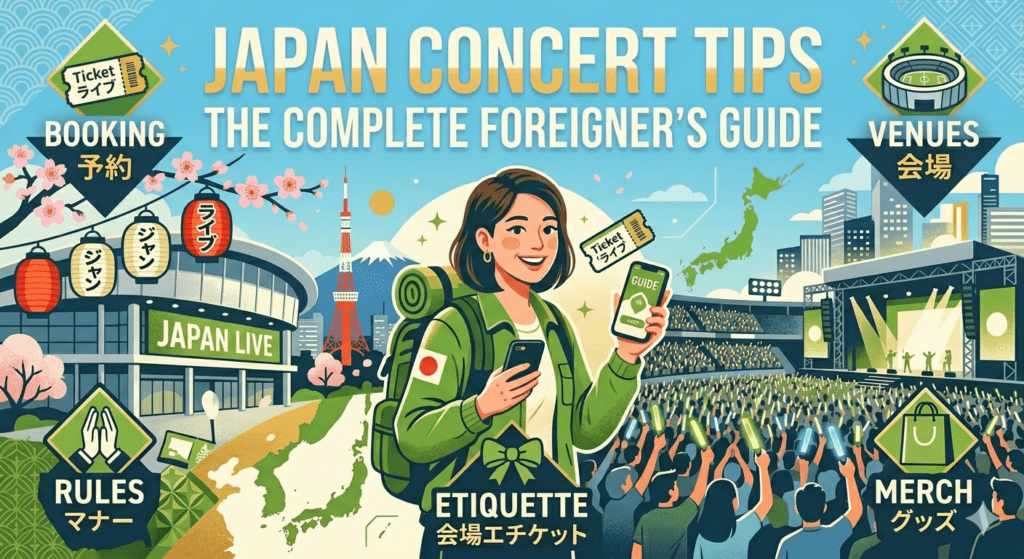
Why Japanese Concerts Feel Different
You’ve secured your ticket — no small feat in itself — and you’re about to experience something genuinely unlike any live show you’ve attended before. Japanese concerts have their own unwritten code: a blend of intense fandom culture, precise etiquette, and logistical complexity that catches first-time international visitors off guard.
This guide covers everything from buying your ticket before you even land in Japan to navigating the last train home after the final encore. Read it once before you go, and you’ll be better prepared than most people in the audience.
Step 1: Buying Your Ticket as a Foreign Fan
The Four Main Ticketing Platforms
Japan’s concert ticketing ecosystem is divided among four major platforms: e+ (eplus), Ticket Pia, Lawson Ticket (L-tike), and LivePocket. Each works slightly differently, but they all share the same core problem for foreign fans: account registration requires a Japanese domestic phone number (an 080, 090, or 070 number). International SIM cards and VoIP numbers are rejected.
Options for Getting Tickets Without a Japanese Number
- e+ International (ib.eplus.jp) — A separate English-language platform that accepts overseas credit cards without a Japanese number. The downside: it only covers roughly 5% of events, mostly major international festivals like Summer Sonic and Fuji Rock. Most J-pop and K-pop dome tours are not listed here.
- Buy a Japanese tourist SIM — Prepaid SIMs with voice and SMS capability (Mobal is the most foreigner-friendly option) give you a real Japanese number. This opens all four platforms, though lottery entries made overseas months in advance are the main use case.
- Proxy ticket services — Third-party services purchase tickets on your behalf. Useful, but expensive, and strict ID-check events (where your name must match the ticket) can cause problems.
- Convenience store walk-in — For general sale tickets that haven’t sold out, you can sometimes purchase directly from a Loppi machine (Lawson) or FamiPort machine (FamilyMart) without an online account. Practical only once you’re already in Japan.
- Official resale — Platforms like Ticket Board (チケットボード) and the official resale functions within e+ and Ticket Pia are increasingly common. Face-value resale is legal; scalping above face value is not.
The Lottery System Explained
Popular concerts don’t sell tickets first-come, first-served. Instead, you apply during an application window, and winners are selected by lottery. There are typically multiple rounds:
- Fan club pre-sale lottery — Open only to registered fan club members. Best seats go here, often weeks before public sales.
- Credit card member pre-sale — Some platforms offer priority access to cardholders of specific banks or card brands.
- General lottery — Open to everyone with an account on the platform. You have roughly the same odds as everyone else.
- General sale — Any remaining tickets go on sale after the lotteries. These sell out within minutes for popular artists; it’s essentially a first-come race with crashing servers.
Losing the lottery doesn’t mean you’re locked out. A second or third lottery round often follows, and official resale channels open closer to the show date.
Important: Name Verification
An increasing number of major concerts — especially K-pop and high-demand J-pop shows — conduct identity checks at the entrance. The name on your ticket must exactly match the name on your passport. If you purchased through a proxy service or used a friend’s account, be aware that you could be denied entry. Always register and purchase with the name on your passport.
Digital Tickets: What to Know
Most major concerts now use smartphone-based digital tickets, typically through apps like AnyPass or the ticketing platform’s own app. A critical detail for foreign fans: your ticket often doesn’t appear in the app until one to three days before the show — sometimes only on the morning of the event. This is completely normal and not a sign that something went wrong. Download the relevant app before you arrive in Japan and make sure you have a working data connection, not just hotel Wi-Fi, on concert day.
Step 2: Arriving at the Venue
How Early Should You Arrive?
The answer depends entirely on whether you plan to buy merchandise.
- Merchandise only — Arrive 3 to 4 hours before doors open. Popular items (tour pamphlets, T-shirts in large sizes, venue-exclusive designs) sell out in the first hour of merchandise sales. The goods queue is a separate process from venue entry.
- No merchandise — 45 to 60 minutes before the listed open time is sufficient for most venues. Add extra buffer at large arenas (Tokyo Dome, Saitama Super Arena) where security lines can be 20–30 minutes long.
Note the difference between the “open” time (開場, kaijō) and the “start” time (開演, kaien) printed on your ticket. The open time is when doors open for entry; the start time is when the show begins. Arriving at the open time is generally ideal.
Coin Lockers: Store Your Bags Before Entering
This is one of the most practical things you can do for yourself. Most major concert venues in Japan either don’t allow large bags inside or strongly discourage them. The good news is that Japan’s network of coin lockers is unparalleled.
Lockers are found both at the train station nearest the venue and at the venue itself (usually outside or in the surrounding complex). Station lockers are almost always more plentiful and cheaper. Sizes and typical prices:
- Small (S) — ¥300–400. Fits a small backpack or large handbag.
- Medium (M) — ¥500–600. Fits a standard backpack or small travel bag.
- Large (L) — ¥700–800. Fits a large backpack or small suitcase.
- Extra Large (XL) — ¥900+. Fits a full suitcase.
Payment is usually by IC card (Suica or Pasmo) or cash. Most lockers no longer accept only cash — IC card payment is widely available and faster. Critical warning: at large-capacity venues like Tokyo Dome or Saitama Super Arena, all nearby lockers fill up 2–3 hours before showtime. Arrive early or store luggage at your hotel.
What to Bring Into the Venue
The good news: Japanese venues are generally bag-friendly. Unlike many Western arenas, you don’t need a clear bag. Messenger bags and backpacks are common. The practical rule is to bring a bag small enough to fit under your seat without blocking the aisle.
Bring:
- Your ticket (app or printed) and your passport (for ID check venues)
- IC card (Suica/Pasmo) — for cashless payment inside and for the train home
- Cash — merchandise windows and small venues sometimes require it; ¥20,000 is a safe budget
- Phone with a fully charged battery and a working data connection
- Portable charger / power bank
- Official penlight if applicable (more on this below)
- A compact, foldable tote bag for merchandise
- Earplugs — optional but useful at stadium shows where the mix can be loud and muddy
Generally prohibited:
- Cameras with detachable lenses (professional cameras)
- Video recording devices
- Selfie sticks and tripods
- Bottles and cans over 1 litre (Tokyo Dome: over 500ml for some events)
- Aerosol cans and noisemakers
- Banners and signs (uchiwa are generally fine; banners are not)
- Umbrellas inside the hall
Smartphone photography during the show is usually prohibited. Some artists allow a brief photo window before the show begins; follow the announcements. Taking photos or video when it isn’t permitted is taken very seriously — you may be escorted out.
Step 3: Merchandise (Goods)
Buying merchandise at a Japanese concert is itself a cultural ritual. Unlike at Western shows where merch is an afterthought, Japanese fans treat the goods queue as a major part of the concert day experience.
What’s Typically Available
- Tour pamphlet — The most important item for collectors. Usually ¥2,500–4,000. Venue-limited; not available online.
- T-shirts — Typically ¥4,000–6,000. Large sizes (XL and above) sell out fastest.
- Official penlight — ¥3,000–4,000. For app-sync shows, essential (see etiquette section).
- Muffler towel — ¥2,000–3,000. Usually available nationally online too, so not urgent to queue for.
- Random goods — Uchiwa fans, acrylic stands, pin badges, trading cards. These are sold in randomized sets by member; you can’t choose who you get. Post-concert trading among fans is common.
Budget ¥15,000–20,000 if you plan to buy multiple items. Most major tour merchandise windows now accept IC cards and QR payment (PayPay, etc.) in addition to cash, but have cash as a backup.
Seiriken: The Goods Queue Number System
At large venues, a seiriken (整理券) is distributed when you arrive — a numbered slip that determines your place in the merchandise queue. Pick it up as soon as you arrive at the venue. Your seiriken number dictates when you’re called to the merch window. If you arrive late, you may wait for hours even if the queue appears short.
Step 4: Concert Etiquette
This is the section that surprises most Western fans the most. Japanese concert culture has its own very specific norms, and understanding them will help you fit in and show respect for the artists and the audience around you.
The Silence Culture
Between songs — and especially during slower or more emotional moments — the audience is often completely silent. No chatter, no phones, no rustling. This silence is a form of respect: it communicates that you’re fully present and that every moment of the performance matters. If you’re used to talking to your friend throughout a show, adjust. The quiet will feel intense at first, but it becomes part of what makes Japanese concerts so atmospheric.
Fanchants and Calls
Many J-pop and K-pop concerts have specific fanchants — predetermined shouts, phrases, and cheers at specific moments in each song. These are not improvised; fans study them beforehand. For K-pop concerts, the chants are often coordinated down to the syllable. For J-pop idol concerts, calls include the names of specific members at specific beats.
You are not required to participate in calls, and you won’t be looked at strangely if you don’t. But learning even a few basic calls for your artist’s most popular songs is a sign of genuine fandom and makes the experience more immersive. YouTube is full of “concert call guide” videos — search “[artist name] live call 応援上映” to find them.
Penlights
At idol and K-pop concerts, official penlights are an integral part of the visual spectacle. Modern official penlights sync wirelessly with the venue system — the entire arena simultaneously changes to the artist’s official color for each song, or each member’s individual color. The result, from the stage, looks like a synchronized sea of light.
If the concert uses this system, using an unofficial penlight or a generic glow stick will simply show a static color, making you visually obvious as not participating in the coordinated display. For concerts that use app-sync penlights, it’s worth buying the official version.
Rules for penlights: wave them but don’t raise them above your own head height (it blocks the view of the person behind you). At some concerts, specific waving patterns are expected for specific songs — observe those around you.
Crowd Culture Varies by Genre
- J-pop / Idol concerts: Fanchants, coordinated penlight waving, extremely high energy but orderly. Jumping and synchronized arm movements are common.
- K-pop concerts: Similar to idol concerts with fanchants, official penlights, and synchronized fan participation. Often features prepared fan banners (uchimaku) in the seated sections.
- Rock / Visual Kei: Moshing in the standing area (sābitto, ‘circle pit’) at heavier shows. Headbanging is common. The energy is visceral but still follows venue rules.
- City pop / Jazz / Acoustic: Concert-hall silence. Polite applause. No phones. Treat it like a classical performance.
Encores
After the main set ends, the lights go halfway up and the audience begins chanting “アンコール” (ankōru, encore) rhythmically. This is a coordinated audience ritual: everyone claps in unison. Join in — it’s one of the most fun moments of any Japanese concert. The artists will return for one or more encore sets.
Step 5: Getting Home After the Show
This is the section most guides skip, and it’s where things go wrong for unprepared foreign fans.
The Last Train Problem
Tokyo’s train network stops running around midnight (roughly 12:00–12:30 AM, depending on the line). Large venue concerts often end at 10:00–10:30 PM, which sounds like plenty of time — but factor in the time to exit a 50,000-person venue and walk to the station, and you may have under 90 minutes to spare. For shows at venues further from central Tokyo (Makuhari Messe, Saitama Super Arena, Yokohama Arena), the return journey takes 40–60 minutes, making the last train genuinely tight.
Before the show, check the last train time for your specific route home using Google Maps or the HyperDia app. Set a mental alarm for when you need to leave the venue. Missing the last train means a taxi (expensive — ¥5,000–20,000 depending on distance) or waiting until the first trains at 5:00–5:30 AM.
Crowd Management After Large Shows
Venues manage post-show crowds with organized exit flows. Staff will direct audience members to the exits in waves or sections — don’t try to push through or ignore these directions. The system is efficient when followed. Attempting to rush out against the flow is both futile and considered rude.
At venues near multiple train stations (Tokyo Dome is near Suidobashi, Korakuen, and Kasuga), spreading the crowd across different stations helps everyone. Consider walking slightly further to a less crowded station rather than joining the massive queue at the most obvious exit station.
Staying Near the Venue
For shows at venues outside central Tokyo, booking a hotel nearby is worth serious consideration. Venues like Makuhari Messe (near Kaihimmakuhari Station) and Saitama Super Arena (near Saitama-Shintoshin Station) have hotels within walking distance. You’ll avoid the last-train panic entirely and can enjoy the post-concert atmosphere with other fans.
Venue Types at a Glance
Japan’s live music venues fall into recognizable categories, each with a slightly different experience:
- Domes (Tokyo Dome, Kyocera Dome Osaka, Fukuoka PayPay Dome) — Capacity 40,000–55,000. Reserved seating. Coin lockers at the venue or nearby. Arrive early; security is thorough.
- Arenas (Saitama Super Arena, Yokohama Arena, Makuhari Messe) — Capacity 8,000–37,000. Mix of seating and standing areas. Usually 30–60 minutes from central Tokyo by train.
- Hall venues (NHK Hall, Tokyo International Forum, Zepp venues) — Capacity 1,500–5,000. Standing floor areas common. Generally excellent sound.
- Live houses (smaller venues 200–1,000 capacity) — Standing only. Drink ticket required on entry (typically ¥500–1,000). Intimate and loud.
Frequently Asked Questions
Can I bring my phone into the concert?
Yes, but you generally cannot use it to record during the show. Phones are how you present your digital ticket at the entrance — having your battery charged and your ticket app ready before you queue is essential. Some events allow brief pre-show photography; the MC will announce this.
Is it okay to attend a concert alone as a foreigner?
Absolutely. Solo attendance is extremely common in Japan — possibly more common than in other countries. There’s no social stigma whatsoever. At standing shows, a solo attendee can often maneuver into better positions than groups.
What if I’m tall and blocking people behind me?
At standing shows, try to position yourself to the sides or behind other tall audience members. Avoid wearing platform shoes or tall hats. Japanese audiences are politely forgiving but genuinely appreciate the consideration.
Do I need to speak Japanese?
Not for large venues. Staff at major concerts are accustomed to international fans. Having a translation app ready is useful for any edge cases (bag check questions, locker payment issues). For smaller live houses, basic Japanese phrases help but are not essential.
How much cash should I bring?
Budget ¥20,000–30,000 for a full concert day: merchandise (¥10,000–15,000), coin locker (¥500–1,000), food and drinks (¥1,500–3,000), transportation, and a cash buffer. Major venues and tour merchandise windows increasingly accept IC cards and QR payments, but small live houses and some locker banks remain cash-only.
Quick Reference Checklist
- ☑ Ticket (app open, battery charged, mobile data working)
- ☑ Passport (required for ID-check events)
- ☑ IC card (Suica/Pasmo) loaded with enough credit
- ☑ Cash ¥20,000–30,000
- ☑ Portable charger
- ☑ Official penlight (for idol/K-pop shows)
- ☑ Foldable tote bag for merchandise
- ☑ Coin locker plan (check venue maps in advance)
- ☑ Last train time noted for your route home
Japanese concerts reward preparation. The more you understand the system before you arrive, the more you can relax and simply enjoy what is, for many visitors, one of the most memorable live music experiences of their lives.