
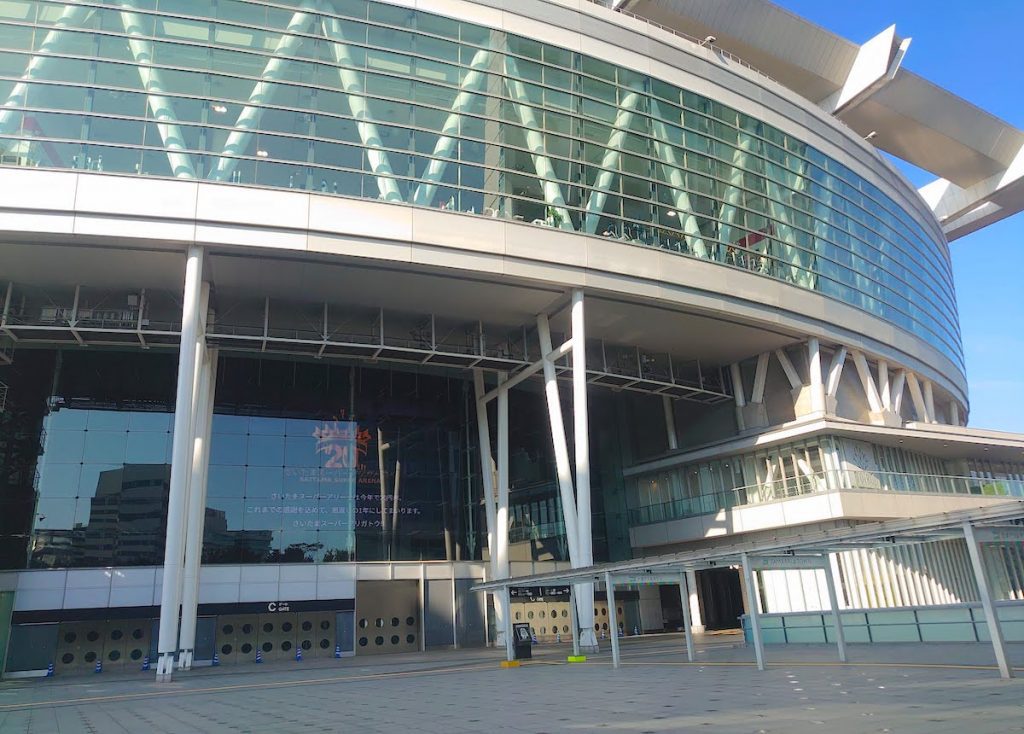
Saitama Super Arena (SSA) is one of the most important concert venues in Japan — the essential step between arena tours and dome tours for any serious artist. Opened in 2000, it’s renowned for its remarkable Moving Block system, which physically transforms the venue between two entirely different configurations. For international fans, it’s also a logistically convenient venue: located just 30 minutes from central Tokyo by train, with station-direct access.
Quick Facts
| Max capacity (Stadium Mode) | ~37,000 |
| Arena Mode capacity | ~19,000–22,500 |
| Concert capacity range | ~12,500–37,000 |
| Address | 8 Shintoshin, Chuo-ku, Saitama 330-9111 |
| Nearest station | Saitama-Shintoshin (JR) — 3 min walk |
| Opened | 2000 |
| Official site | saitama-arena.co.jp |
Capacity & Seating Breakdown
The Two Modes: Arena vs. Stadium
SSA’s defining feature is its Moving Block — a 15,000-ton structure that moves 70 meters horizontally to open or close the far end of the venue. This creates two fundamentally different venue shapes:
| Mode | Shape | Capacity range | Typical use |
|---|---|---|---|
| Arena Mode | Rounded bowl | ~19,000–22,500 | Most concerts, basketball |
| Stadium Mode | Full oval | ~30,000–37,000 | Major dome-scale concerts, large events |
For concerts, the actual capacity within each mode varies further depending on whether the arena floor is standing or seated, and how much space the stage structure and runway occupy. A K-pop act with a large center-stage setup in Stadium Mode might accommodate 28,000–32,000, while a rock show with end stage and maximum standing floor could reach 35,000+.
Important: Stadium Mode concerts in SSA require consent from nearby residents due to noise and safety considerations. Stadium Mode shows are therefore less frequent — Arena Mode is the default for most concerts. When a ticket states “Stadium Mode,” it’s a significant event.
Seating Levels
SSA uses a level numbering system based on floor number. The first digit of your level number corresponds to the floor:
| Level label | Floor | Description |
|---|---|---|
| Arena Level | 1F | The floor — standing or seated depending on event |
| 200 Level | 2F | Lower stands; same level as Saitama-Shintoshin Station entrance (A/B/C Gates) |
| 300 Level | 3F | Mid-level stands; partly balcony seating |
| 400 Level | 4F | Upper stands (N Gate entrance) |
| 500 Level | 5F | Highest tier; balcony seating |
Stage Configurations
SSA does not have a permanent stage — the configuration changes entirely per event. Two main patterns are used for concerts:
- End Stage 1 — Stage at one end of the arena (in Arena Mode, typically opposite the Moving Block wall). Seats behind the stage may be blocked or sold as rear stage. The best views are from 200 Level directly opposite the stage.
- End Stage 2 — Stage positioned along the long side of the arena floor (more common in Stadium Mode). This creates a wider stage with more seats having direct front-facing views, but fewer seats in the “front row” zone.
- Center Stage — Used by some K-pop and J-pop acts for 360° audience viewing. Maximizes engagement at the cost of slightly reduced arena floor capacity.
The official SSA website posts confirmed staging patterns for upcoming events before tickets go on sale — check their event schedule page for your specific concert.
Which Section Should You Choose?
- Best for energy: Arena Level (floor) — standing, closest to stage, highest crowd intensity
- Best overall balance: 200 Level center blocks opposite the stage — seated, good sightlines, close enough to feel the performance
- Best for visual overview: 300–400 Level center — elevated view of stage lighting, penlight displays, and production
- Avoid if possible: Arena Level near the stage rear (if end stage), 500 Level side sections — furthest from stage with angled views
How to Get There
Saitama Super Arena is connected directly to Saitama-Shintoshin Station (3-minute walk). The 200 Level entrance (A/B/C Gates) is on the same floor as the station walkway — you can enter the venue without going outdoors. For a full step-by-step photo access guide: Saitama Super Arena Access Guide →
| Station | Line | From Tokyo |
|---|---|---|
| Saitama-Shintoshin | JR Keihin-Tohoku / Utsunomiya / Takasaki | ~30 min from Ueno |
| Kita-Yono | JR Saikyo Line | ~5 min walk from SSA |
Coin Lockers
Coin lockers are available inside SSA on the 2nd floor (200 Level) concourse, on the north side. These are accessible after passing through the entrance gates.
| Location | When accessible | IC card |
|---|---|---|
| SSA 2F north concourse | After entry gates | Yes |
| Saitama-Shintoshin Station | Before entry | Yes |
Station lockers at Saitama-Shintoshin typically have better availability than at Tokyo central venues, but still fill up for major sold-out shows. The provisional cloakroom service may be offered by event organizers — check your ticket or the artist’s official event page for details.
On Concert Day
Recommended Arrival Times
- Merchandise: 3–4 hours before open time. SSA merchandise windows open outside the arena, and queues for major K-pop or J-pop shows form very early.
- Entry only: 45–60 minutes before the open time. Security lines are generally faster here than at Tokyo Dome.
- Coin lockers: Saitama-Shintoshin station lockers are typically accessible until around 2 hours before showtime for larger events.
Bag Policy & Prohibited Items
Standard prohibited items follow Japan’s concert norms: professional cameras with detachable lenses, video recorders, selfie sticks, aerosol cans, noisemakers, glass bottles, and canned drinks (SSA specifically prohibits glass bottles and cans on the arena floor). Bags are subject to inspection. No clear bag requirement is in force, but large suitcases are not permitted inside.
Food & Drink
Food stalls are available on the concourse levels inside the venue. The adjacent Keyaki Hiroba (欅広場) outdoor plaza has additional food and restaurant options — this area is particularly pleasant for pre-show meals. Multiple convenience stores are within a 5-minute walk of the station.
Getting Home After the Show
Last trains from Saitama-Shintoshin Station run until approximately 11:50 PM toward Ueno/Tokyo. For concerts ending around 10:00–10:30 PM, this gives comfortable time to exit and catch the train. The station connects directly to the 200 Level entrance, so the exit flow is efficient compared to outdoor venues.
For Stadium Mode concerts with 30,000+ attendees, exit can be congested. Staff manage the flow in sections — remain patient and follow instructions rather than rushing to the station.
Frequently Asked Questions
What is Saitama Super Arena’s capacity?
It depends on the mode. In Arena Mode, capacity ranges from roughly 19,000 to 22,500. In Stadium Mode (the full venue with the Moving Block open), maximum capacity reaches approximately 37,000. Concert capacity within each mode varies further by stage configuration — most concerts fall between 20,000 and 35,000.
What’s the difference between Arena Mode and Stadium Mode?
Stadium Mode opens the Moving Block, expanding the venue into a full oval shape and adding roughly 9,000 seats. Arena Mode closes the block, creating a more intimate bowl shape. Most concerts use Arena Mode; Stadium Mode is reserved for the highest-demand events and requires special permissions due to sound levels.
How far is Saitama Super Arena from Tokyo?
Approximately 30 minutes from Ueno Station by JR Keihin-Tohoku Line to Saitama-Shintoshin Station. The venue is a 3-minute walk from the station and connected indoors at the 200 Level.
Are there coin lockers at Saitama Super Arena?
Yes, on the 2nd floor (200 Level) north concourse, accessible after entering the venue. Station lockers at Saitama-Shintoshin are available before entry. Both fill up for major shows — arrive early.
What does “200 level” mean on my ticket?
The first digit represents the floor number — 200 Level = 2nd floor, 300 Level = 3rd floor, and so on. Arena Level refers to the ground floor (1F). The A, B, and C Gates are on the 200 Level and connect directly to the station walkway.