
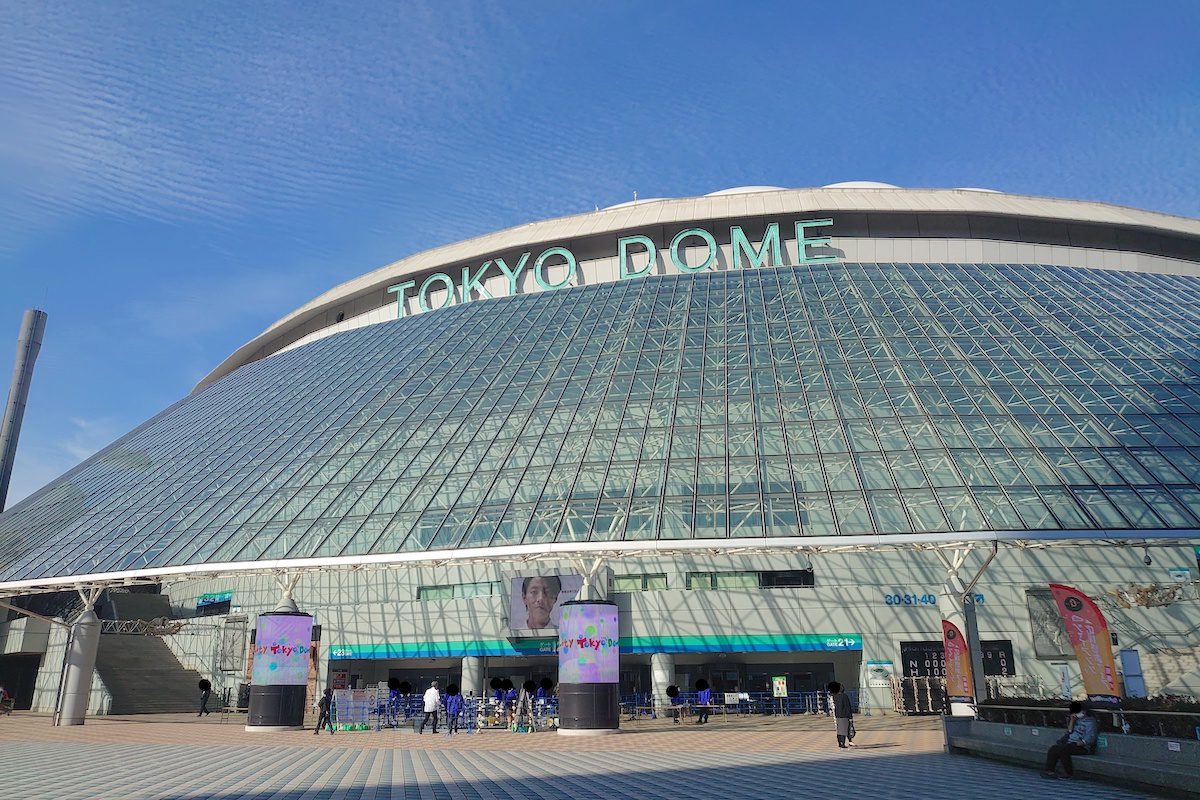
Tokyo Dome is Japan’s most iconic indoor venue and the ultimate milestone for any artist touring the country. Opened in 1988 as Japan’s first domed stadium, it has hosted everyone from Michael Jackson and The Beatles to BTS, Taylor Swift, and Bruno Mars. For international fans planning to attend a concert here, understanding the venue’s layout, capacity, and logistics makes the difference between a stressful day and a seamless one.
Quick Facts
| Max concert capacity | ~55,000 |
| All-seating capacity | ~42,000 |
| Address | 1-3-61 Koraku, Bunkyo, Tokyo 112-8575 |
| Nearest stations | Suidobashi (JR), Korakuen (Metro), Kasuga (Toei) |
| Opened | March 1988 |
| Roof | Air-supported dome (all-weather) |
| Official site | tokyo-dome.co.jp |
Capacity & Seating Breakdown
Configuration by Event Type
Tokyo Dome’s capacity shifts significantly depending on how the floor is configured. Concerts that use the arena floor for standing (the inner field area) can reach the upper end of the range, while all-seated shows with a fixed stage sit lower.
| Event type | Approximate capacity |
|---|---|
| Concert (standing floor + all stands) | ~50,000–55,000 |
| Concert (seated floor + all stands) | ~45,000–50,000 |
| All-seating configuration | ~42,000 |
| Baseball (home game) | ~43,500 |
The most commonly cited figure of “55,000” represents the maximum configuration with standing arena floor seating and all stands filled. In practice, most concerts run between 45,000 and 50,000, as stage structures, catwalks, and runways reduce available standing space on the field.
Seating Areas Explained
Tokyo Dome has three main seating zones for concerts:
Arena Floor
The inner field — the baseball diamond and outfield — becomes the standing or seated floor area for concerts. When standing, this is the closest you can get to the stage, but sight lines depend heavily on where you’re positioned relative to the stage. Block positions (A, B, C, etc.) vary by artist’s stage design. Arena floor tickets are typically the most sought after and often distributed via lottery among fan club members.
1st Floor Stands
The fixed seating surrounding the arena floor on the lower level. Seats closest to the stage (directly behind the performance area) offer excellent visibility. Side stand seats (along the first and third base lines) have angled views but are generally well within comfortable viewing distance. Outfield stands (right and left field) are the furthest from the stage and typically seat fans at angles; these sections are sometimes blocked off for smaller concerts.
2nd Floor Stands
The upper tier wrapping around the entire dome. Seats here are elevated, which can actually provide a clear overhead view of the stage and any lighting or drone effects. The trade-off is distance — artists appear small without binoculars. For concerts with elaborate stage productions (domes, screens, synchronized penlights), the visual impact from the upper stands can be surprisingly powerful.
Stage Configurations
The stage setup changes significantly between artists and tour types, and it directly affects which seats offer the best experience.
- End stage — The most common setup. Stage positioned at one end of the dome (typically the centerfield wall side). Seats behind the stage are either blocked off or sold as “rear stage” seats with a secondary screen. Best seats are in the infield stands directly opposite the stage.
- Center stage / 360° — A circular or square stage positioned in the middle of the arena floor, with the audience surrounding it on all sides. Maximizes capacity and ensures no seat is “rear stage.” Common for major J-pop and K-pop artists who design tours specifically for dome venues.
- Runway / catwalk — Many acts extend the stage into the arena floor via a runway, allowing artists to get closer to standing audience members. This reduces the standing capacity but dramatically improves the experience for floor ticket holders.
Which Section Should You Choose?
Since Tokyo Dome uses a lottery system (not first-come-first-served), you generally cannot select your preferred section. However, understanding what you’re getting helps manage expectations.
- Best for closeness: Arena floor — highest energy, closest to the stage, standing
- Best for overall view: Lower infield stands, rows toward the middle — seated, clear sightlines, good distance from speakers
- Best for visual spectacle: Upper stands — elevated view of light shows, synchronized penlights, and stage design
- Rear stage seats: Sold at a discount or allocated last — secondary screens provided, but not ideal
How to Get There
Tokyo Dome is served by three stations within walking distance. For a full step-by-step photo guide from each station, see our dedicated access guide: Tokyo Dome Access Guide →
| Station | Line | Walk time |
|---|---|---|
| Suidobashi | JR Chuo-Sobu Line | ~2 min |
| Korakuen | Tokyo Metro Marunouchi / Namboku | ~5 min |
| Kasuga | Toei Mita / Oedo | ~5 min |
Coin Lockers
Tokyo Dome has coin lockers located within the Tokyo Dome City complex (outside the dome itself, in the shopping and amusement area). Station-based lockers are available at Suidobashi and Korakuen.
| Location | Sizes available | IC card payment |
|---|---|---|
| Tokyo Dome City complex | S / M / L | Yes |
| Suidobashi Station | S / M / L | Yes (most units) |
| Korakuen Station | S / M | Yes |
Critical note: All lockers in and around Tokyo Dome fill up 2–3 hours before showtime for sold-out events. For evening concerts, lockers are often gone by 4:00 PM. If you’re coming with luggage directly from a hotel check-out or the airport, plan to store bags elsewhere — the dome does not offer an official cloakroom for large items. Tokyo Dome is now a fully cashless facility; all transactions inside use IC cards or QR payment — bring your Suica or Pasmo loaded with sufficient credit.
On Concert Day
Recommended Arrival Times
- Buying merchandise: Arrive 3–4 hours before the listed open time. Venue-exclusive items and large-size T-shirts sell out within the first hour of goods sales.
- No merchandise: 45–60 minutes before the open time is sufficient for most shows, though security lines at sold-out dome concerts can run 20–30 minutes.
- Coin lockers: Arrive before 4:00 PM for evening shows to guarantee a locker.
Bag Policy & Prohibited Items
Tokyo Dome performs bag checks at the entrance. There is no strict size limit published for bags, but large suitcases and rolling luggage are not permitted inside. A bag that fits under your seat is the practical guideline.
Standard prohibited items include: professional cameras with detachable lenses, recording devices, selfie sticks and tripods, bottles and cans over 1,000ml (and frozen items), aerosol cans, noisemakers and megaphones, and banners. Smartphones are permitted but recording during the performance is prohibited at virtually all concerts.
Food & Drink
Food and drink concession stands are available inside the dome on the concourse level. Options include Japanese fast food, beer, soft drinks, and snacks. Outside food is generally not prohibited, but bottles and cans must comply with the size rules above. The wider Tokyo Dome City complex has restaurants and convenience stores if you want to eat before entering.
Getting Home After the Show
Concerts typically end between 9:30 PM and 10:30 PM. Last trains from Suidobashi (JR) run until approximately 12:30 AM; from Korakuen (Metro) until roughly midnight. The post-show crowd exits over 30–40 minutes, so you generally have time to make the last train — but check your specific route before the show, not after.
Venue staff direct audience members in organized exit waves — follow their guidance rather than rushing. Consider exiting toward Korakuen or Kasuga stations rather than Suidobashi, which receives the largest share of the departing crowd.
Frequently Asked Questions
What is Tokyo Dome’s capacity for concerts?
For concerts, Tokyo Dome typically accommodates between 45,000 and 55,000 people depending on the stage configuration. The maximum figure of ~55,000 applies when the arena floor is used for standing and all stand sections are open. Baseball games use a fixed configuration of approximately 43,500 seats.
Is Tokyo Dome all-seated or is there a standing area?
It depends on the artist and tour. Many concerts designate the arena floor (inner field) as a standing area, while all stand sections are seated. Some concerts run fully seated configurations. Your ticket will specify “arena” (floor/standing) or a stand section and row number.
Can I bring a bag into Tokyo Dome?
Yes. Bags are subject to security inspection at entry. Large suitcases and rolling luggage are not permitted inside. A bag small enough to fit under your seat is the practical standard. No clear bag requirement exists.
Is cash accepted at Tokyo Dome?
No. Tokyo Dome became a fully cashless venue. All purchases inside — food, drinks, and merchandise — require IC card (Suica/Pasmo) or QR code payment (PayPay, etc.). Load your IC card before arriving.
Are there coin lockers at Tokyo Dome?
Yes, in the Tokyo Dome City complex and at nearby stations. They fill up 2–3 hours before sold-out events. For large luggage, use luggage storage services outside the complex or leave bags at your hotel.
How far in advance should I arrive?
For merchandise: 3–4 hours before open time. Without merchandise: 45–60 minutes before open time. For coin locker access: before 4:00 PM for evening shows.