
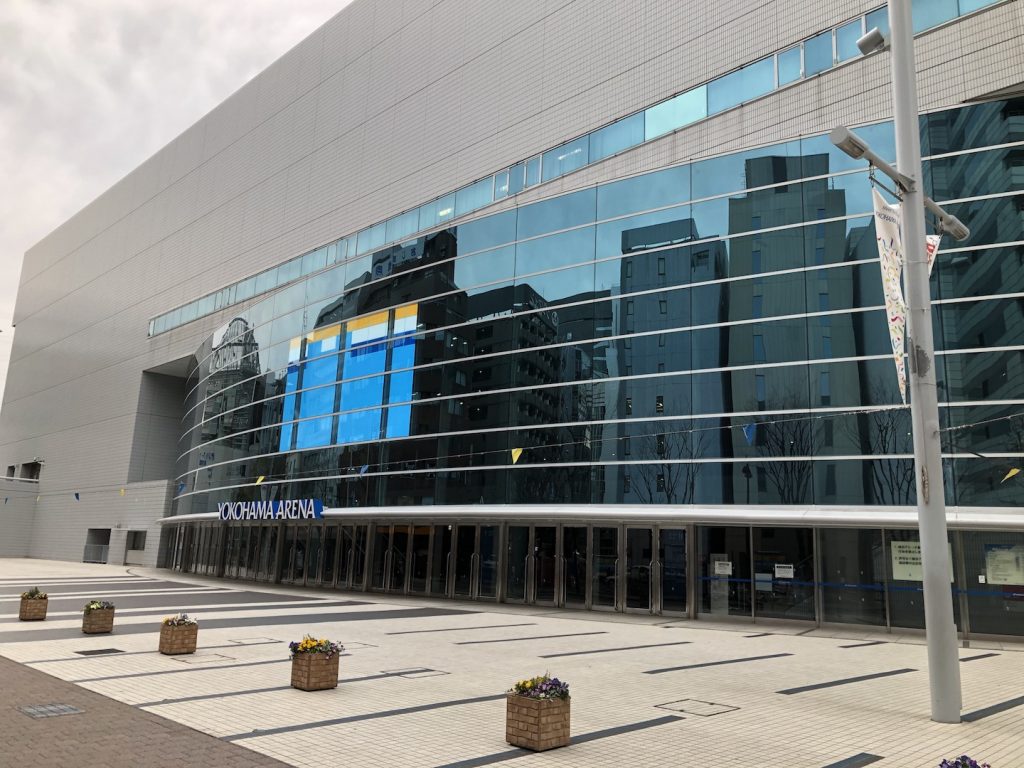
Yokohama Arena has been one of the most important mid-large concert venues in Japan since it opened in 1989, modeled conceptually after Madison Square Garden in New York. With a maximum capacity of 17,000, it occupies a sweet spot between the intimacy of smaller halls and the scale of dome venues — large enough for major artists, but close enough that even rear stand seats feel connected to the performance. It’s a frequent home for K-pop concerts, J-pop arena tours, and international artists’ Japan dates.
Quick Facts
| Maximum capacity | 17,010 |
| Movable seats | ~10,560 (Lambda system) |
| Arena floor area | ~7,619 m² |
| Address | 3-10 Shinyokohama, Kohoku-ku, Yokohama 222-0033 |
| Nearest station | Shin-Yokohama (JR Yokohama Line / Tokaido Shinkansen / Yokohama Municipal Subway) — 5 min walk |
| Opened | April 1989 |
| Official site | yokohama-arena.co.jp |
Capacity & Seating Breakdown
The Lambda Movable Seating System
Yokohama Arena’s key feature is its Lambda system — a computer-controlled movable audience seating system comprising approximately 10,560 seats that can be reconfigured for different event types and sizes. This allows the venue to scale from an intimate 10,000-person concert setup to its full 17,000-person capacity.
| Configuration | Approximate capacity |
|---|---|
| Full capacity (concert) | 17,010 |
| Mid-scale concert setup | ~12,000–15,000 |
| Smaller concert / Lambda partial | ~10,000 |
| Conference / exhibition | 2,000–4,000 |
Unlike Saitama Super Arena’s dramatic physical transformation, Yokohama Arena’s reconfiguration is handled entirely by computer-controlled seat movement — the basic shape of the venue remains constant, but sections can be opened or closed to suit the event size.
Seating Areas
Arena Floor
The flat floor area in the center of the venue. For concerts, this is either standing (general admission) or divided into seated blocks. The arena floor has excellent sightlines to the stage for front sections; depth perception decreases toward the back of the floor, but the enclosed venue shape means even the back of the floor is relatively close to the stage.
Stand Seating (1st–3rd tiers)
The fixed and Lambda-movable stands wrap around the arena floor in curved tiers. Yokohama Arena’s design emphasizes clear sightlines — the stands are steeply raked and angled toward the stage, meaning elevated seats have a clearer downward view than in many comparable venues. Side and rear sections exist but are less pronounced than at octagonal venues like Nippon Budokan.
Suite and Box Seats
The 3rd floor features 2 suites (20 seats total) and 8 boxes (120 seats total). These are typically reserved for corporate events and are not available through general ticketing.
Stage Configurations
- End stage — Most common. Stage at one end of the floor, audience facing it on three sides. Rear section behind the stage typically blocked or sold as rear stage.
- Center stage / runway — Used by some K-pop and J-pop acts. Runway extending from the main stage into the arena floor brings artists closer to floor audience members.
- Half-stage — Smaller events or sub-arena configurations with part of the Lambda seating closed off, reducing effective capacity to 10,000–12,000.
Sound Quality Notes
Yokohama Arena uses a computer-controlled sound system with 43 directional powered speakers and full digital mixing. The system is calibrated to adjust for different seating configurations, making it one of the better-sounding large arenas in the greater Tokyo area. The relatively enclosed shape helps contain sound more effectively than domed venues of larger capacity.
Which Section Should You Choose?
- Best for energy and closeness: Arena floor standing — direct stage access, highest crowd energy
- Best balanced experience: Lower stands, center blocks facing the stage — seated, clear sightlines, good sound
- Best overhead view: Upper stands center — elevated but well-angled; light shows look spectacular from height
- Rear stage sections: Available at discount but require reliance on secondary screens
How to Get There
Yokohama Arena is a 5-minute walk from Shin-Yokohama Station, which is served by multiple lines including the Tokaido Shinkansen (bullet train). For a step-by-step photo access guide: Yokohama Arena Access Guide →
| Station | Line | From Tokyo |
|---|---|---|
| Shin-Yokohama | JR Yokohama Line / Tokaido Shinkansen | ~25 min from Shinjuku (JR) |
| Shin-Yokohama | Yokohama Municipal Subway Blue Line | Direct from Yokohama Station |
| Shin-Yokohama | Tokyu Shin-Yokohama Line | Direct from Shibuya area |
Coin Lockers
Coin lockers are available at Shin-Yokohama Station. The station has multiple locker banks across its various exits and platforms. For large events, lockers fill up — arriving at least 2 hours before showtime is recommended if you need locker space.
| Location | Sizes | IC card | Note |
|---|---|---|---|
| Shin-Yokohama Station (JR side) | S / M / L | Yes | Multiple banks near ticket gates |
| Shin-Yokohama Station (Subway side) | S / M | Yes | Fewer units; fill quickly |
| Inside Yokohama Arena | Check event info | Varies | May be available via organizer |
Yokohama Arena does not have a permanent public coin locker bank inside the venue. Some event organizers provide temporary cloakroom or locker services — check the official event page for your specific concert.
On Concert Day
Recommended Arrival Times
- Merchandise: 2–3 hours before open time. Merchandise tables are set up outside or in the lobby area. K-pop and idol shows in particular have long goods queues.
- Entry only: 30–45 minutes before open time. Security at Yokohama Arena is efficient; the 5-minute walk from the station is straightforward and well-signposted.
- Coin lockers: Arrive at least 2 hours before showtime if you need station lockers.
Bag Policy & Prohibited Items
Standard Japanese concert venue rules apply: professional cameras with detachable lenses, video recorders, selfie sticks, and aerosol cans are prohibited. Bags are subject to inspection but do not need to be clear or of a specific size — bring a bag that fits under your seat comfortably. Large suitcases and rolling luggage are not permitted inside.
Food & Drink
Concession stands are available inside the venue during events. The Shin-Yokohama area has a good range of restaurants and the CUBE Plaza shopping complex directly adjacent to the station has food options on multiple floors. Multiple convenience stores are within 2–3 minutes of the arena entrance.
Getting Home After the Show
Shin-Yokohama Station has good last train coverage across its lines. JR Yokohama Line last trains run past midnight; Yokohama Municipal Subway also runs late. The Tokyu Shin-Yokohama Line provides a direct connection to Shibuya and Shinjuku areas. For concerts ending around 9:30–10:30 PM, the last train situation is generally comfortable — but verify your specific route before the show.
Post-show crowds exit to the station in a reasonably organized flow. The wider Shin-Yokohama area has more space than many inner-city venues, reducing the bottleneck effect typical of events at Budokan or Tokyo Dome.
Frequently Asked Questions
What is Yokohama Arena’s capacity?
The maximum capacity is 17,010. This figure applies when all Lambda movable seating is deployed and the arena floor is at full capacity. Most concerts run between 12,000 and 17,000 depending on the stage setup and whether floor seating is standing or seated.
How far is Yokohama Arena from Tokyo?
Shin-Yokohama Station is approximately 25 minutes from Shinjuku Station by JR Yokohama Line. From Shibuya, the Tokyu Shin-Yokohama Line provides a direct connection. From Tokyo Station, the Tokaido Shinkansen reaches Shin-Yokohama in about 12 minutes, though the JR conventional line is more practical for daily fare.
Are there coin lockers at Yokohama Arena?
Yokohama Arena does not have permanent public coin lockers inside. Use the coin lockers at Shin-Yokohama Station (multiple banks available near the ticket gates). For major shows, arrive at least 2 hours early to secure a locker.
Is Yokohama Arena standing or seated?
It depends on the event. The arena floor can be configured as standing (general admission) or seated. All stand sections (upper and lower tiers) are always seated. Your ticket will specify your section and, for floor tickets, whether the event is standing or seated.
What artists have performed at Yokohama Arena?
Yokohama Arena has hosted an enormous range of artists since 1989. Notably, it was the opening venue for Yumi Matsutoya (Yuming) in 1989. Regular performers include most major J-pop artists on arena tours, and it’s a frequent K-pop venue with acts including BTS, Twice, Stray Kids, and many others having performed multiple nights here.